Wu Wei or non-action

Author: Renata Serna Hosie, Director of Methodologies at the Prolongar Foundation


Thoreau said
"Affecting the quality of the day: that is the greatest of the arts"

From time to time I make sure to remember Wu Wei's concept to remind myself that I can allow things to be and unfold in their own way. By evoking it, I allow myself to reduce the effort in the actions I perform, from the smallest to the largest. I remember it in my daily life and I remember it in the workshops we do at the Prolongar Foundation.

The concept of Wu Wei, which means not to do, represents one of the most important principles in Taoist philosophy. It does not refer to a state of inactivity or stagnation and does not imply dispensing with the will or mental activity. Quite the contrary: cultivating non-action is a great challenge, perhaps a paradox?, that of effortless effort. Wu Wei means acting from a place of stillness, stopping to contemplate, being present in practice in a way that allows you to feel without analyzing.
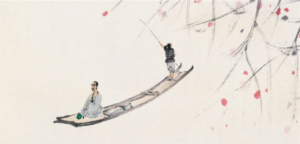
When I remember it in my daily practice, I usually start by silencing myself;
I seek to be comfortable and comfortable and I make sure I am not straining; for example, I go through the muscles that support the shoulders and connect the head, and if I am lying on the ground, I make a micro-movement of the shoulder towards the sky that ends up lying the entire wall of my scapula back on the ground; I reconfirm that there is no muscle tissue suspended or making unnecessary effort; I also recognize what is present in me, what moves and emerges without any intention; I look inside, my anatomy; I like to imagine that I am empty and loose: nowhere to go, but I know, too, that something else will happen.
Perhaps, I like the space of my practice so much because I do not have to apply any formula.

It may not be easy to understand the joy and taste of non-action, for in our Western culture we place great value on action and progress:

"The need to be productive by maintaining a single focus on objectives implies that doing predominates over being, longing over will, complexity over simplicity, artifice over the natural, that analysis replaces reflection and intuition is conditioned by the intention that conditions the action" (Manrique, M. E).

Whereas, in Wu Wei's philosophy, when being prevails over doing, the calmness of the mind is experienced, the attention span is sharpened and this opens the possibility of acting from full consciousness.

Attention is precisely one of the most important psychological processes in the workshops we carry out in Prolongar. Sharpening and expanding the capacity of attention, of focus, means learning to perceive what I do and how I do what I do. Only then can we extend the repertoire of options to choose from (choose what is closest to what I really want or need). Attention allows us to be observers of our experience and when we increase awareness of our own body, we can stimulate the brain and access the capacity for transformation and to be creative. Alejandro Convers, a somatic educator in Colombia, says that "attention is the foundation of presence."
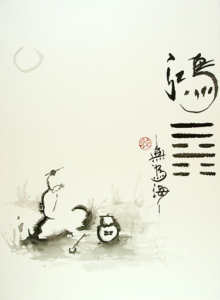
Remembering the concept of Wu Wei in the work we do in Prolong prepares us for one of the great pursuits of the process: reconciliation with one's own life story. Stop resisting, releasing tensions accumulated in the tissues of the body, abandoning the desire to change what was or learning to think about ourselves from multiple and changing identities.

The work we do in the foundation does not aim to change, in the short term, some material difficulties faced by the participants. We do not guarantee them housing, health insurance or a daily meal. But then, as Doralba asked us in the last project, "And what is this for?"

 Silencing inside, being aware of the air that comes and goes, noticing the disposition and tensions in the body, recognizing how we are in the moment without wanting to change, is not intended to lead us to see that things are going very well and that everything is perfect, but rather to sustain the present moment with everything that already is. Honor our own life history and the memory archive that we are. The work of self-inquiry and observation that I propose from my experience of Wu Wei and that is almost always a root work and has the quality of the invisible, does not push change, rather allows it to emerge by itself, in times almost always unsuspected. That's effortless effort: it happens when the action performs on its own.

From the beginning of Wu Wei nothing is forced, the execution of the action unfolds beyond all technique, all thought. You may have ever felt the particular weariness that results from imagining, longing, speculating, that things happen in a specific or different way than they are. I do, and perhaps part of that's why every so often I make sure to remind myself that I can eliminate unnecessary effort and use the energy I invest more efficiently. Allowing things to be and unfold in their own way opens up space for me internally and softens my way of being.


References:

Manrique Maria Eugenia. Art, nature and spirituality. Taoist evocations. Editorial Kairós, 2017. 

Kabat-Zinn. Mindfulness in everyday life. Paidós. 2009.

Convers Alejandro. Principles of Somatics, 2019.
KALEIDOSCOPE: the blog on strategic creativity for social change

Author: María Elisa Pinto García – Executive Director of Fundación Prolongar

We started 2020 by launching the Kaleidoscope blog, a space for reflection on our work through artistic and communication languages to achieve sustainable and integral transformations at the individual, interpersonal and group level. The Kaleidoscope will feed on stories of transformation that strengthen our vocation of service and dedication day by day; of learnings, challenges, dilemmas and satisfactions that germinate in our work; and reflections that the national and international situation raises where we seek to contribute and share.

We wanted to begin this process of reflection by taking stock of 2019, a year of achievements, important changes within our organization and great alliances. During 2019, within the framework of the "Art to Rebuild" project funded by USAID, and other initiatives developed in partnership with Tell, the Ministry of National Education and the High Council for Victims of Bogotá, we managed to reach 736 people, including 120 children and adolescents, 31 adult victims of the armed conflict, 23 retired veterans of the Public Force and 6 people in the process of reintegration, and 556 visitors to the exhibition "Improbable Encounters". We work in different cities of the country such as Bogotá, Medellín, Popayán, Quibdó, Santa Marta and Tuluá.

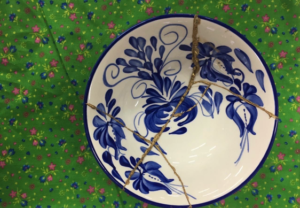
On the other hand, we launch our new website in English and Spanish, as well as the Amalgam line that collects the technique and metaphor of Kintsugi and brings it to Colombian culture to promote transformation and repair fractures in various populations and contexts. Instead of trying to hide the flaws and cracks, or staying anchored in what doesn't work or is needed, we conceive that the fracture has a perspective of opportunity and learning. Like an amalgam, we seek the connection of elements that at first may be of a contrary or different nature.

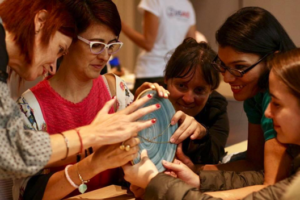
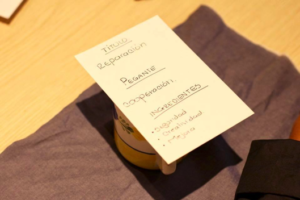
Within the framework of the Amalgam for Work Teams line , we had the opportunity to work with the teams of IDARTES, Museo Casa de la Memoria de Medellín, COMFAMA, Parque Jaime Duque and leaders of some Caribbean organizations, in alliance with Azaí Consultores. In the Amalgama para la Vida line, where we carry out workshops open to the public for personal development, we were participating in the seminars "Culture & Art for Social Transformation" in Bogotá and "For a Reconciled Country" in Medellín, in addition to carrying out a Kintsugi workshop with our ally Casa Let. In this sense, the Amalgama line has sought to contribute from different edges, sectors and populations to the construction of peace and transformation.

"One of the central objectives of the Foundation is to create bridges between art and public policy, as well as to participate in the central discussions that Colombia is having in the post-agreement"

Photographer: Federico Mejía

On the other hand, one of the central objectives of the Foundation is to create bridges between art and public policy, as well as to participate in the central discussions that Colombia is having in the post-agreement. Therefore, we have been linked since 2018 to the Technical Table on Disability of the Truth Commission, where we seek to contribute to the construction of the final report from our work with victims of antipersonnel mines and art as a vehicle of resistance, truth and memory. Additionally, through the article "21N: Essential Readings" we suggest some authors who can shed light on the framework of the national strike that the country has been experiencing since last November.

I would like to conclude by naming two international scenarios in which we participate, and with which we manage to expand our horizon of work in the future. The first of these was an exchange of experiences that took place in Northern Ireland, a region that experienced an armed conflict of almost 30 years that ended with the signing of the "Good Friday Agreement" in 1998. The exchange brought together initiatives from three resilient cities (Medellín, Cali and Belfast) and allowed us to understand from the experience of Northern Ireland the enormous relevance of psychosocial accompaniment processes and the transformation of cultural violence after the signing of a peace agreement. 20 years later, the region has one of the highest suicide rates in Europe and other serious mental health problems. We strengthened our conviction to continue working in this area not only in Colombia, but in other parts of the world.

"A millenary practice and metaphor has been adapted to the Colombian context to connect and reconcile a society as fragmented as ours"

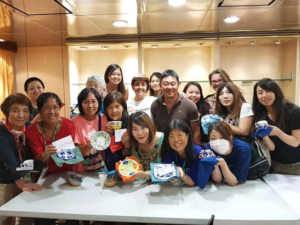
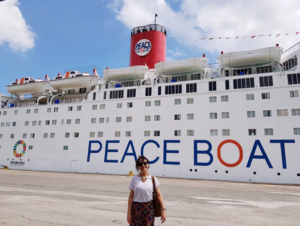
The second space was the "Peace Boat ", one of the most important NGOs in Japan whose team invited us to give two lectures on the Jamaica – Colombia route on the armed conflict, the Colombian peace process and the contributions of our Foundation during these years. We also advanced a Kintsugi workshop that was very successful and that for the first time allowed us to show the Japanese how an ancient practice and metaphor has been adapted to the Colombian context to connect and reconcile a society as fragmented as ours.

We hope that this kaleidoscope will be nourished not only by our articles and reflections, but also by your comments, suggestions and contributions. Your reading and feedback will be very valuable for our team but especially, for those people who star in our work.